- Bear Car Care
Bad suspension announces itself before it fails completely. A rough ride over bumps that used to feel smooth, a car that drifts or pulls when you try to drive straight, or a front end that dips sharply under braking — any of these is your car telling you something in the suspension system needs attention.
Most drivers notice something feels off long before they bring it in. The problem is that suspension wear is gradual. You adjust to the new normal without realizing how much worse it has gotten. This guide covers what bad suspension actually feels like, what causes it, what the repair costs, and why letting it go is more expensive than fixing it now.
What Does Bad Suspension Feel Like?
Bad suspension makes your car feel unstable, vague, or rough in ways a car with healthy suspension does not. The most common complaints are a bouncy or floaty ride over rough road, the car pulling to one side without steering input, and a clunking or knocking sound when hitting bumps or potholes.
These symptoms do not all mean the same thing. A clunk over bumps points to a different problem than a car that drifts or floats. Understanding what you are feeling helps narrow down what actually needs to be repaired.
7 Signs Your Suspension Needs Attention
1. Rough or Bouncy Ride
Your car should absorb bumps without bouncing repeatedly after it hits one. If the front or rear continues to bounce or oscillate after going over a bump, the shock absorbers or struts are worn out and no longer control the spring movement. This is the most common suspension complaint.
2. Car Pulls or Drifts to One Side
A car that drifts to one side on a flat, straight road either has an alignment problem, a worn suspension component, or uneven tire wear causing it. Pulling that started suddenly after hitting a pothole usually points to a bent component or a tire knocked out of alignment. Gradual drift that developed over time is usually wear-related.
3. Nose Dives Under Braking
If the front of the car dips sharply when you brake, the front struts or shocks are worn. Healthy shocks control how the weight transfers during braking. Worn shocks let the nose dive, which increases stopping distance and reduces steering control — both safety concerns.
4. Clunking or Knocking Over Bumps
A clunk or knock that happens specifically when going over bumps, dips, or rough pavement usually means a worn ball joint, tie rod end, sway bar link, or control arm bushing. These are the pivot and connection points in the suspension, and when they wear, they develop play that produces noise. Clunks can also indicate a strut mount that has failed.
5. Uneven Tire Wear
Suspension problems cause tires to make inconsistent contact with the road, which produces uneven wear patterns. Cupping — a scalloped or wavy pattern across the tire tread — is a common sign of worn shocks or struts. Tires wearing on one edge more than the other usually point to an alignment issue caused by a worn suspension component.
6. Steering Feels Loose or Vague
If turning the wheel requires more effort, or if there is noticeable play before the car responds, the steering and suspension components are connected enough that suspension wear often degrades steering feel. Worn tie rod ends, ball joints, and steering rack bushings all contribute to a loose, imprecise steering feel.
7. Visible Fluid Leaks on the Shock or Strut Body
Shock absorbers and struts are filled with hydraulic fluid. When the seal fails, you will see oily residue or streaking on the outside of the shock body. A leaking shock is a shock that is not working. It needs to be replaced, not topped off.
What Causes Suspension Problems?
Suspension components wear out from two things: miles and road conditions. Cincinnati’s road network gives both in abundance.
Potholes and frost heaves are particularly hard on ball joints, tie rod ends, and strut mounts. A single hard hit can knock a wheel out of alignment or crack a strut mount that had been marginal. Beyond that, normal wear from constant movement and exposure to road salt, moisture, and temperature extremes degrades rubber bushings over time.
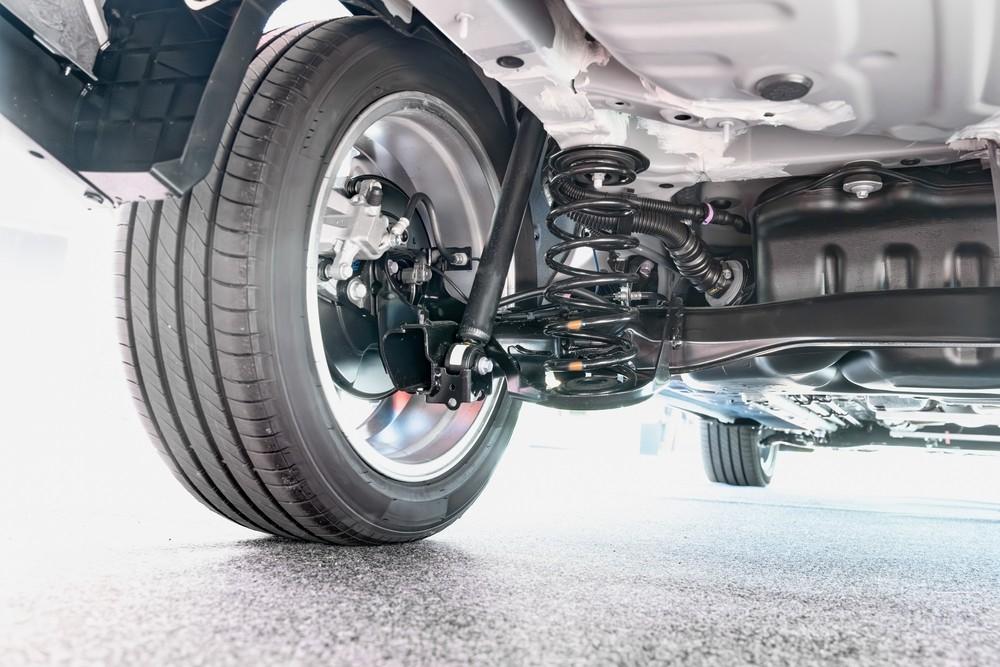
The most commonly replaced suspension components include:
- Shock absorbers and struts — wear gradually over 50,000 to 100,000 miles depending on road conditions
- Ball joints — the pivot points connecting the wheel hub to the control arms
- Tie rod ends — connect the steering rack to the wheels; worn tie rods cause both steering and alignment problems
- Sway bar links and bushings — control body roll in corners; one of the most common sources of a clunk over bumps
- Control arm bushings — rubber mounts that allow controlled movement in the suspension arms
How Much Does Suspension Repair Cost?
Suspension repair costs vary significantly depending on what needs to be replaced and what vehicle you drive. Here is a realistic breakdown:
- Shock or strut replacement (per axle): $300 to $900 parts and labor
- Ball joint replacement: $200 to $700 per joint depending on vehicle
- Tie rod end replacement: $150 to $650 per side
- Sway bar links: $75 to $300 per side
- Control arm replacement: $300 to $900 depending on vehicle
- Alignment (required after most suspension repairs): $80 to $320
Most suspension repairs also require a wheel alignment afterward. Replacing a worn component without aligning the wheels means uneven tire wear and a car that still does not drive straight.
The National Highway Traffic Safety Administration identifies suspension and steering failures as a contributing factor in a significant number of vehicle crashes annually — which is worth knowing when you are deciding whether to put off a repair.
What Happens If You Ignore Bad Suspension?
Ignoring bad suspension costs more than fixing it, almost without exception. Here is why.
Worn shocks and struts accelerate tire wear. A set of tires that should last 50,000 miles will wear out in 30,000 on a car with bad shocks. That is money spent on tires that a suspension repair would have preserved.
Worn ball joints and tie rod ends fail progressively, and a complete failure while driving is a serious safety event. A ball joint that separates at highway speed means the wheel collapses inward and you lose control of the vehicle.
Deferred suspension repairs also compound. A worn component changes how force is distributed through the rest of the system. A bad strut puts more stress on strut mounts and ball joints. Fixing one worn component after another is more expensive than replacing them together when the labor is already open.
What a Suspension Inspection at Bear Car Care Covers
We do not guess at suspension problems. When you bring your car in for a suspension concern, we put it on the lift and physically check every component: shocks and struts, ball joints, tie rod ends, sway bar links, control arm bushings, and wheel bearings. We check for play, leaks, cracking, and wear.
You get a clear report on what we found, what needs attention now, and what can wait. We do not recommend repairs you do not need.
After any suspension work, we perform a four-wheel alignment at Bear Car Care to make sure the vehicle is tracking straight and your tires wear evenly.
FAQ: Car Suspension Repair
How do I know if my suspension is bad?
The most reliable signs are a bouncing or floating ride, a car that pulls to one side, clunking over bumps, nose-diving under braking, and uneven tire wear. Any one of these is worth having inspected.
Can I drive with bad suspension?
It depends on what is wrong. Worn shocks are drivable but accelerate tire wear and reduce vehicle control. A worn ball joint or tie rod end is a more urgent safety concern — if one of those fails completely while you are driving, you lose steering control. Get it inspected before deciding whether it can wait.
How long do shocks and struts last?
Most shocks and struts last 50,000 to 100,000 miles under normal driving conditions. Cincinnati road conditions, particularly pothole season in late winter and early spring, tend to shorten that range. If your car has over 70,000 miles and has never had suspension work, it is worth having everything checked.
Do I need an alignment after suspension repair?
Almost always yes. Any time a component that affects wheel angle is replaced — tie rod ends, ball joints, control arms, struts — an alignment is required to bring the wheels back into spec. Skipping the alignment after a suspension repair means your tires will wear unevenly and the car will not track straight.
What is the difference between shocks and struts?
A shock absorber is a standalone component that controls spring bounce. A strut is a structural part of the suspension that also contains a shock absorber inside it — replacing a strut is a more involved job because it is load-bearing. Your vehicle has one or the other depending on the design; most modern cars use struts on the front and shocks on the rear.
Why is my car pulling to one side after hitting a pothole?
Hitting a pothole hard enough can knock a wheel out of alignment, bend a tie rod, or crack a strut mount. If the pull started right after hitting something, get it inspected before driving it further. Continued driving with a bent component can damage other parts.
How much does a full suspension inspection cost?
At Bear Car Care, we inspect the full suspension system as part of an overall vehicle inspection. Call us or check online for current pricing.
Ready to Get Your Suspension Checked?
If your car is riding rough, pulling, clunking, or just not feeling right, our team at Bear Car Care will tell you exactly what is going on.
Call us or schedule an inspection online at bearcarcare.com. Most inspections take about an hour, and you will leave knowing exactly what your car needs.